After a Year of Watching Animation with My Child, I've Realized Language Habits Are More Important Than Memorizing Vocabulary
A parent shares their experience using DualView to help a child who struggles with traditional studying develop a natural love for English through animations.

After a Year of Watching Animation with My Child, I've Realized Language Habits Are More Important Than Memorizing Vocabulary
Many parents ask me:
"Should I actually let my child watch English animations?" "Will they just be watching for the plot?" "Can they really learn English this way?"
To be honest, I had the same doubts before.
And I had an extra layer of worry.
Because my child is not like those "well-behaved" kids who can sit still and memorize vocabulary on their own.
He has endless ideas and his eyes light up when he speaks; when you chat with him, you can tell his mind is racing. But the moment the same content is turned into a page of text to be "read," he sighs. Asking him to sit quietly and finish an English book has never been an easy task.
So, as for "getting him to learn English," I've tried and given up several times.
Until one day, I noticed that while watching animations, he had naturally begun to understand simple sentences.
It wasn't because he had memorized a lot of words.
It was because he was exposed to English every day.
Our Biggest Problem Wasn't the Materials
Children today don't lack learning resources.
There are plenty of online courses. Plenty of English picture books. Plenty of cram schools.
But for our family, the materials were never the problem.
The real difficulty was this:
How to keep a child who struggles to focus for long periods and finds "reading words" particularly taxing willing to continue engaging with English.
I discovered early on that what actually gets him to sit down isn't a textbook, but characters on a screen that move and talk. He can watch dynamic content for a long time; with static text, his mind drifts away after about three minutes.
It's not that he isn't serious; it's just that it's hard for him to pretend to be interested in things he genuinely isn't.
If every English lesson felt like a class, he would shut down quickly.
But what if he's watching an animation he actually likes?
It's a completely different story.
Starting with Entertainment, Not Learning
Our family loves watching Disney animations together:
- Zootopia
- Moana
- Frozen
- Inside Out
Previously, when we turned on Chinese subtitles, he hardly noticed the English and just focused on the plot.
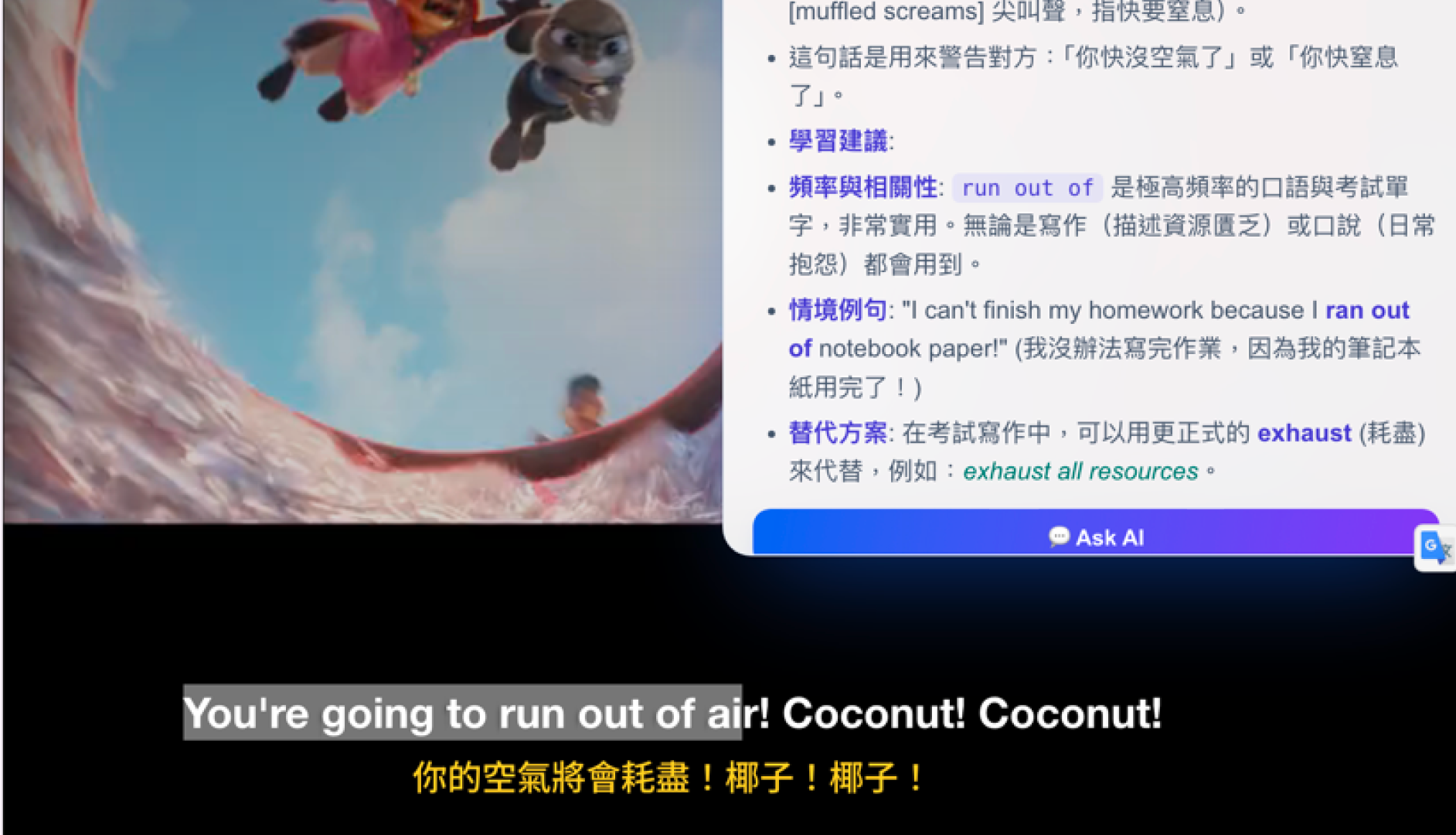
Later, I started trying to have both English and Chinese subtitles displayed simultaneously—one line of English above, one line of Chinese below, perfectly aligned.
Something magical happened.
He began comparing them on his own:
"Oh, so this Chinese sentence is said like this in English." "So when characters are angry, they use this expression." "This phrase wasn't taught in the school textbook."

He wasn't "studying."
He was simply curious.
And I noticed a small detail that was particularly important for him: when he encountered a word he didn't understand, he could just click it, and the meaning would pop up on the screen, along with the actual human pronunciation. For a child who prefers "listening" over "reading," this is far friendlier than making him look it up or spell it out himself. He never has to leave the video, so his attention is never broken.
Features I Discovered Later That Helped Us
Truthfully, at first, I just wanted bilingual subtitles.
But as I used it, I found several small features that felt like they were designed specifically for a child like mine—
The ability to set an automatic pause after each sentence. In the past, he often "realized what happened only after the scene had passed." Now, the screen pauses cleanly at the end of each sentence without darkening, giving him time to digest the sentence before deciding whether to proceed. The pace is now under his control.
For sentences he doesn't understand, he can repeat them one by one or loop a short segment. He doesn't have to scrub back and guess the timeline; one click takes him back to that sentence. Listening to the hard parts a few more times puts zero pressure on him.
The ability to hide subtitles, let him guess, and then reveal them. To him, this doesn't feel like reviewing; it feels like clearing a level in a game.
I didn't use all of these at the start; I discovered them gradually while watching with him. Looking back, it was these small designs—"no interruptions, giving time, and reducing the reading burden"—that made him willing to keep watching.
Language Habits Are More Important Than Language Proficiency
What many parents care about most is:
- How many words does the child know now?
- Can they get a high score on tests?
Honestly, if I had kept focusing on those two things, I probably would have given up long ago—because if measured by "how many words are memorized," my child would never be the one with the impressive grades.
But I've come to feel that the truly important thing is actually something else:
Whether the child is willing to continue engaging with the language.
If a child is willing to watch 20 minutes of English content every day,
That's over 120 hours of input per year.
And it's completed in a relaxed, happy state without resistance.
This accumulation is often more valuable than forcing him to sit and memorize words—especially for a child who "cannot be forced."
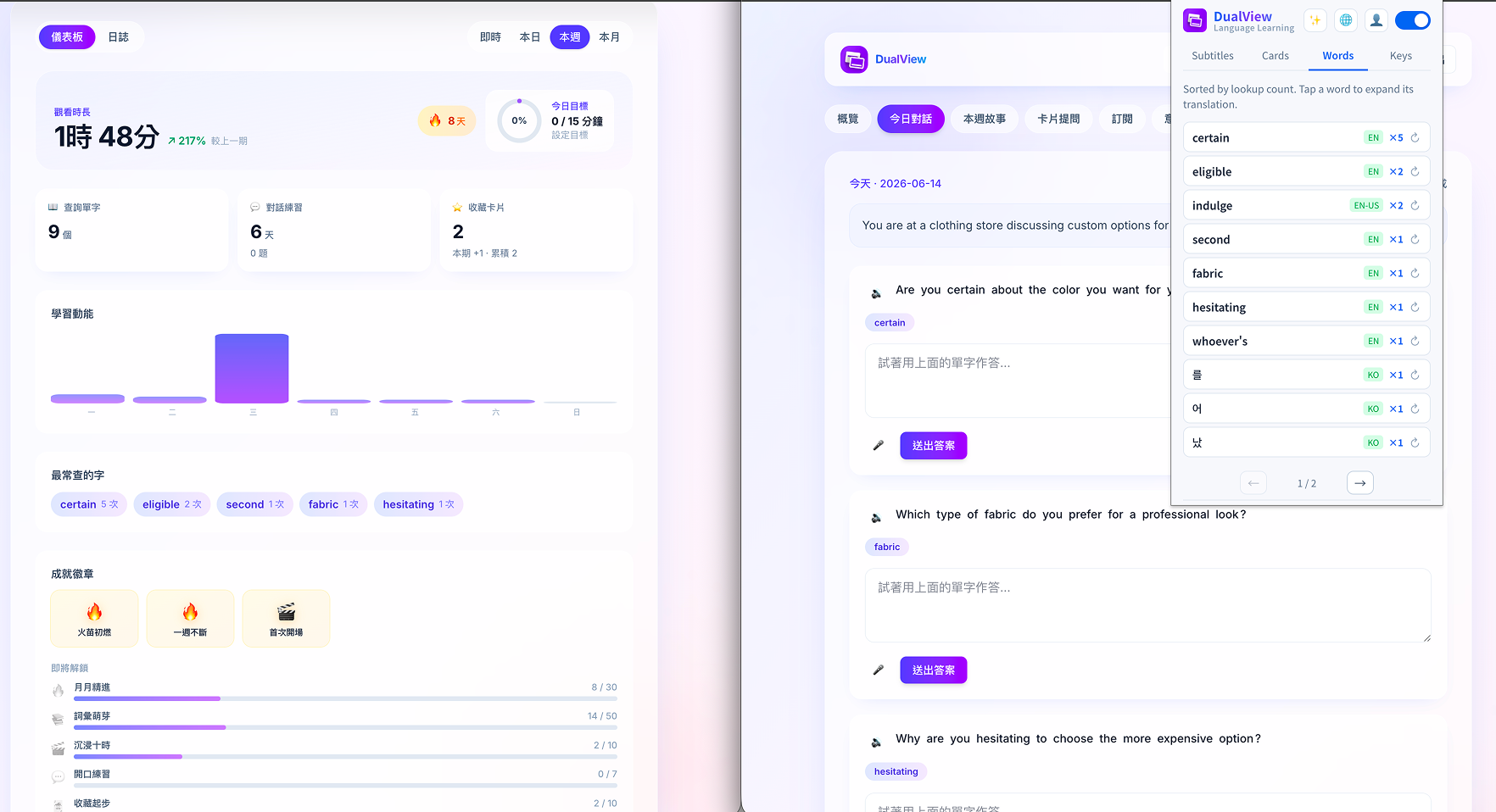
I also love that it silently keeps track of this accumulation: the words he's looked up, the hours watched, the learning footprints—all becoming visible records. For a child often told he "can't sit still," seeing "Wow, I've already learned this much" provides a sense of achievement that textbooks cannot give.
Why This Tool Stayed in Our Home
Actually, the reason I keep using it is that it solved a problem I personally had.
Previously, when I wanted to use videos to learn a language, I often had to:
- Pause
- Open a dictionary
- Search for a meaning
- Switch back to the video
The entire experience was very fragmented.
I thought then: if adults find it tedious, imagine a child who already struggles to maintain focus. Once there's a break or a distraction, he's gone.
So what really made me stay is that it makes these things natural:
- Bilingual subtitles are layered directly on the video for instant comparison.
- Look up words and hear pronunciation without leaving the video.
- Click to learn more when he encounters content he's particularly interested in.
It integrates learning into the process of watching, rather than interrupting the process of watching.
For my child, those words "no interruptions" practically determined whether he could sustain the habit.
What I Expect Is Not Instant Mastery
I never expected his English to skyrocket after watching a few animations.
That's not how languages are learned.
What I expect more is—
That one day, when he sees English, he won't feel afraid first. That when he wants to know the meaning of a word, he is willing to explore it proactively. That as he grows, he can naturally use English as a tool to acquire knowledge.
Developing language proficiency takes time, but developing a language habit can start today.
And for many families, perhaps it starts with just one evening of watching animations together.
Ready to take your learning further?
Create a free account to unlock AI translation, word cards and daily practice.